
Chapter 17: AI in Marketing and Advertising
- Zack Edwards
- Nov 25, 2025
- 38 min read

My Name is David Ogilvy: Founder of Ogilvy & Mather
I was never meant to be an advertising man, at least not according to the expectations of my youth. I wandered through occupations like a restless traveler—chef, farmer, salesman—each role teaching me more about people than any formal classroom ever could. I learned what stirred desire, what shaped trust, and what caused suspicion. These early lessons would one day become the backbone of my life’s work.

Learning the Power of Persuasion
My first true glimpse into persuasion came while selling AGA cookers door-to-door. It was a grueling job, but it taught me how to listen before I spoke. I observed customers closely—their anxieties, their hopes, their unspoken questions. Through these interactions, I discovered that words were not merely noise; they were instruments that, when used wisely, could change minds. I wrote a manual on selling that caught the eye of my future mentors, and that single document nudged me toward the world where I truly belonged: advertising.
Building Ogilvy & Mather
When I founded Ogilvy & Mather in 1948, I was not yet experienced in the craft of advertising. But I brought with me uncommon convictions—that good advertising must be rooted in research, that the customer is not a moron, and that great ideas come from understanding people, not manipulating them. We began in a small room with little more than ambition and a handful of clients willing to take a chance on us. Over the years, our agency grew into one of the most influential in the world. Brands trusted us not because we were flashy, but because we delivered results guided by curiosity, discipline, and a relentless search for truth in consumer behavior.
Mastering Copywriting and Branding
I believed fervently that copywriting was a craft worthy of reverence. Every headline, every line of body copy, every call to action needed purpose and clarity. My team learned to treat words like diamonds—precious, polished, and sharp. I encouraged them to research relentlessly, borrowing ideas from psychology, literature, and even anthropology. The key was always to speak to the customer with respect and intelligence. Branding, too, was not merely about logos or colors; it was about the tone, promise, and personality of a company. A brand was a relationship, and like any relationship, it was built through consistent and meaningful communication.
The Science Behind Persuasion
Although many saw advertising as manipulation, I viewed it as a science supported by creativity. I insisted on testing, measuring, and analyzing everything we produced. If a headline could be better, we tested it. If an advertisement performed well one month and poorly the next, we searched for reasons. This scientific approach—rare in my early years—became a defining element of modern advertising. It taught us that success was reproducible when built on insight, data, and discipline.
A Legacy Echoing into the AI Era
Though I left the world before artificial intelligence reshaped it, I recognize in these new tools reflections of my earliest beliefs. AI-driven copywriting echoes my demand for clarity and relevance in messaging. Algorithms analyzing customer behavior feel like extensions of the research departments I championed. Automated A/B testing mirrors my insistence on experimentation. Even AI segmentation aligns with our old pursuit of understanding not the masses, but the individual within them. In a sense, the advertising world has finally acquired the tools I always wished we had—machines that help us understand people more deeply, not less.
A Life of Curiosity and Craft
I spent my life chasing the perfect blend of science and art, logic and emotion, truth and persuasion. My legacy is not in the buildings that bear my agency’s name, but in the principles that have endured: respect the customer, cherish research, write with purpose, and never stop learning. If those ideas continue to shape the evolving world of AI-enhanced marketing, then I will have done something worthwhile.
Understanding Modern AI-Driven Marketing – Told by David Ogilvy
When I walked the halls of advertising agencies in my lifetime, much of what we did relied on a blend of research, instinct, and experience. Today, however, you stand at the threshold of a transformation unlike anything the industry has witnessed. Artificial intelligence has ushered in an era where decisions can be made with extraordinary accuracy. Marketers now see patterns that once remained hidden and reach audiences with messages tailored to their individual interests. What was once a slow art of observation has become a rapid science of insight.

The Shift from Intuition to Information
In my day, intuition was valuable—sometimes necessary. But it was also dangerous, for intuition is little more than a refined guess. Modern AI-driven marketing elevates decision-making from guesswork to grounded analysis. Algorithms now read through oceans of data, revealing customer preferences, behaviors, and motivations with an efficiency that would have astonished my generation. This shift means that your creative ideas no longer float in uncertainty. They are supported by evidence that gives them strength and direction.
Transforming Customer Acquisition
The old challenge of finding your audience has been radically simplified. AI tools analyze demographic markers, browsing habits, purchase histories, and even emotional patterns in customer interactions. They identify prospects who are most likely to respond, then adjust targeting strategies in real time. Where we once relied on segmenting broad groups of people, AI now allows you to communicate as though you were speaking directly to one individual at a time. Customer acquisition has become a dance of precision, guided by the machine’s ability to predict human behavior.
The Evolution of Brand Storytelling
I long believed that great advertising should tell a compelling story. AI has not replaced this principle; in fact, it has strengthened it. By understanding what different audiences respond to, AI helps refine stories so they resonate more deeply. It can test variations of tone, pacing, and imagery to discover what combination captures attention and earns trust. Modern brand storytelling is no longer limited by the creator’s assumptions. Instead, it evolves constantly, shaped by data that reflects the audience’s real reactions.
The Power of Continuous Learning
One of the most remarkable qualities of AI is its ability to learn endlessly. In my era, testing was deliberate and slow. We studied results over weeks or months, then adjusted accordingly. Today, AI analyzes performance in real time, adapting strategies moment by moment. If a campaign begins to falter, AI can diagnose the cause quickly. If a message resonates unexpectedly, AI scales it across platforms instantly. The result is a marketing ecosystem that responds to the marketplace with a kind of living intelligence.
The Marriage of Art and Science
Despite these innovations, the essence of advertising remains unchanged: you are still speaking to real human beings with real desires. But now you have tools that blend creativity with near-perfect accuracy. Data informs the message, and imagination shapes it. Together, they form a partnership that would have thrilled me. For all the progress AI has brought, it has not replaced the need for insight, empathy, and clear communication. Instead, it provides the strongest foundation yet for those qualities to thrive.
A Future Built on Understanding
Modern AI-driven marketing is not merely a technological shift; it is a philosophical one. It calls for humility, a willingness to test assumptions, and a commitment to understanding the customer more deeply than ever before. Armed with AI, you can now deliver messages that are not only persuasive but profoundly relevant. If you embrace this evolution, you will discover that advertising has never been a more powerful or insightful profession than it is today.
My Name is Claude Hopkins: Pioneer of Scientific Advertising
I was born in 1866, long before the age of digital metrics or the idea that selling could be a science. Yet even as a child, I felt drawn to the patterns in human behavior. I watched how people chose certain products, how they talked about value, and how their decisions were rarely random. These simple observations stayed with me as I grew, eventually shaping the principles that would define my life’s work.
Finding My Path into Advertising
I did not set out to be an advertising pioneer. My early jobs were practical and ordinary, but each one taught me something about how people think. I noticed that persuasion had structure. I paid attention to what caught someone’s interest, what changed their tone, or what nudged them toward action. When I finally entered the world of advertising, I brought with me not charisma or flashy ideas, but a deep respect for logic and a desire to uncover what truly motivated a customer.
The Birth of Scientific Advertising
When I began writing advertisements, I realized quickly that opinions meant very little. What mattered was proof. I became convinced that advertising should be measurable, repeatable, and based on facts rather than creative whims. This belief led me to test everything—headlines, offers, wording, placement, and timing. I introduced coupons not as a gimmick, but as a way to track responses. For the first time, an advertisement could be evaluated with real numbers. We could see what worked and what did not. The results did not lie, and they reshaped our entire industry.
Understanding the Consumer Through Data
I believed that the customer should guide every decision. But to understand the customer, we needed more than guesswork. We needed methods that revealed how people behaved in real situations. Measuring responses through coupons, letters, or sales data helped us uncover patterns—who bought, why they bought, and what message reached them best. This was the beginning of consumer measurement, long before computers made such analysis effortless. At the time, it felt revolutionary simply because it removed the blindness from advertising and replaced it with clarity.
Writing “Scientific Advertising”
In 1923, I gathered my principles, tests, observations, and methods into a short book titled “Scientific Advertising.” I did not expect it to become a foundational text for generations of marketers. To me, it was simply a collection of truths I had learned through trial and error. But those truths resonated. They showed that advertising could follow rules. They proved that creativity alone was insufficient without structure and accountability. In many ways, the book described A/B testing decades before the term existed. We tested two versions of an advertisement, compared results, and refined based on performance. It was simple, but it worked with remarkable consistency.
A Legacy Foreshadowing the AI Era
I did not live long enough to witness the rise of artificial intelligence, but I understand its core purpose. AI is built on data, patterns, tests, and measurable outcomes—the very foundations I championed. Where I used coupons and handwritten records, AI uses real-time analytics. Where I measured ads by mail responses, AI analyzes thousands of data points instantly. Where I ran split tests manually, AI runs them continuously and at massive scale. In many ways, AI is the realization of the world I imagined: one where advertising decisions are informed not by opinion, but by truth revealed through data.
A Life Devoted to Understanding Why People Choose
My life’s work was not about selling products, but about understanding people. Every test, every coupon, every measured response brought me closer to the patterns beneath human choice. If my methods continue to guide modern marketers—now assisted by machines far more powerful than anything I knew—then my pursuit of clarity was worthwhile. I always believed that advertising, when done right, was simply applied knowledge. And knowledge, whether gathered by hand or with AI, will always lead us to better decisions.
AI for Copywriting and Ad Messaging
In the world of marketing, the leap from manual copywriting to AI-powered content creation is as dramatic as the leap from the printing press to the internet. Tools like ChatGPT, Jasper.ai, and Copy.ai now handle headlines, taglines, ad scripts, and email campaigns with a speed and scale unimaginable just a few years ago. The art of persuasive writing meets the precision of algorithms. In this story I’ll walk you through how these tools work, best practices for using them, prompt structures you can adopt, and some important legal and regulatory cases to keep on your radar.
How the Tools Generate Copy
Here’s how it typically works: You provide a prompt to the tool—a short description of what you want (for example: “Generate three subject lines for an email campaign promoting a new eco-friendly water bottle aimed at outdoor enthusiasts”). The system leverages a large language model that has been trained on massive datasets of text, learns patterns of messaging, tone, structure, and persuasion, and then outputs suggestions. For instance, a prompt to Jasper.ai might be: “Write a punchy ad headline for an athletic-wear brand’s spring launch, aimed at 18-34 year olds, highlighting sustainability and performance.” Copy.ai might be asked: “Create five taglines for a luxury skincare launch with anti-aging benefits, keeping the tone aspirational and minimalist.” ChatGPT can be used for longer scripts: “Draft a 60-second video ad script introducing a new smart home thermostat, highlight ease of use, cost savings, eco-friendly features, close with a strong call to action.” The output then becomes a draft that the marketer edits, refines, and adapts for brand voice, target audience, and placement.
Best Practices for Prompting and Refinement
To get the best results from these AI tools, certain practices stand out. First: be specific in your prompt. The more context you provide—target audience, tone, unique selling proposition, call to action—the better the output will align. Second: treat the output as a starting point, not a final product. You still need to apply brand voice, check for accuracy, ensure relevance, and edit for clarity. Third: test and iterate. Generate multiple variations and A/B test which one performs better. Fourth: use human-in-the-loop oversight. Even advanced tools will produce errors, off-brand messaging, or suggestions that lack nuance. Fifth: monitor and regulate for ethical and legal compliance—don’t rely blindly on the machine. In practice, you might prompt ChatGPT with “Create three email subject lines for a back-to-school campaign for a tutoring platform; audience: parents of high-school students; highlight early birds save $50; tone: friendly and urgent.” Then review the five subject lines produced, pick two top candidates, revise one of them to better align with brand voice, then test both to see which generates higher open rates.
Legal and Regulatory Considerations in AI-Generated Copy
As we embrace AI for copywriting, we must also pay attention to the legal landscape. One key domain is copyright and training data: when AI tools generate copy, are they using material that may infringe someone’s rights? For example, one recent federal ruling held that AI-generated summaries that closely tracked the structure and expressive choices of news articles may plausibly infringe copyright. Copyright Lately+1 Another area is hallucination or false output—while not specific to advertising copy, it speaks to the risk of relying on AI without checking. For example, there have been dozens of cases where lawyers cited fake legal precedents generated by AI tools, leading to sanctions. National Law Review+1 Though these cases are in the legal-practice domain, the principle applies to marketing copy too: output must be reviewed for accuracy, originality, avoid misleading claims, and comply with advertising regulations. Lastly, privacy and algorithmic bias can enter the picture if the AI tool uses personal data to tailor copy or targets certain groups—marketers must ensure compliance with consumer-protection laws.
Practical Example Workflow
Let’s walk through a practical workflow: Step 1: Define your campaign: brand, product, audience, tone, key message. Step 2: Write a prompt: “Generate four social-media ad headlines (max 8 words) for a new vegan snack bar targeting millennials who live in urban apartments; focus on flavor, convenience, and ethical sourcing.” Step 3: Use the tool (say Copy.ai) and receive four headline options. Step 4: Select two, refine them (perhaps shorten one, adjust the phrasing to match brand tone). Step 5: Create deliverables: ad script, email subject lines, body copy, visuals (if applicable). Step 6: Set up performance testing (e.g., two versions of an email: Version A uses AI-generated subject line “Snack fresh, snack bold”, Version B uses refined version “City snack heroes crave when life moves fast”). Step 7: Monitor metrics: open rate, click-through, conversion, cost per acquisition. Step 8: Iterate based on results—generate new variations, update prompt parameters, refine further. Step 9: Document what worked, why, and build an internal playbook for future campaigns. Step 10: Review legal/brand compliance: check claims (e.g., “vegan”, “ethical sourcing”), ensure no copyrighted phrases were used improperly, ensure targeting does not violate privacy guidelines.
Looking Ahead: The Human + Machine Partnership
Ultimately, AI in copywriting is neither a replacement for human creativity nor a magic bullet that delivers perfect copy automatically. It is a tool—a dramatically powerful one—that augments what human writers and marketers do best: empathize with an audience, craft narratives, connect emotionally, and steer strategy. Your role as marketer is evolving: you become prompt designer, editor, strategist, tester. The AI becomes collaborator—generating, refining, scaling. The smartest campaigns will emerge when human insight and machine speed are combined thoughtfully. As you step into this new territory, remember that the message still matters, the audience still matters, and your brand voice still matters. With the right prompts, processes, reviews, and ethics in place, you’re poised to harness AI for copywriting and ad messaging in ways that deliver impact—and respect the craft.
AI-Enhanced Customer Segmentation & Personalization – Told by Claude Hopkins
In my era, segmentation was built slowly, through coupons, letters, and long observation. Today, you have tools that reveal in seconds what once took months to uncover: the differences between buyers, their motivations, their hesitations, and what message will persuade one person but not another. AI-enhanced segmentation allows you to see not a crowd, but a collection of individuals—each with unique patterns that can be understood and acted upon. In truth, it is the fulfillment of what I always believed: advertising should speak to people as they are, not as we imagine them to be.

How AI Analyzes Behavior and Demographics
Modern platforms record nearly every interaction a customer has with your brand—every click, glance, purchase, hesitation, and preference. AI organizes these actions into patterns that would have amazed my generation. Tools like HubSpot AI examine demographics such as age, location, and income, but they go far beyond simple categories. They study browsing time, email engagement, product viewing habits, abandoned carts, and even the sequence in which a person interacts with your website. With thousands of signals collected, the AI identifies segments that would have been invisible to the naked eye: night-time browsers who only buy during sales, loyal customers who respond to emotional language, newcomers who need more education before making a purchase.
Creating Micro-Targeted Messaging
Once these segments are identified, personalization begins. Marketing automation platforms allow each message to be crafted for each group, almost as if you were writing an individualized letter. HubSpot AI, for example, can produce different email content for distinct audiences: a headline emphasizing urgency for bargain-seekers, a softer approach for customers who prefer storytelling, a product comparison for analytical buyers. On social media, AI tools tailor captions and imagery to match the tone that each audience segment responds to best. The process mirrors what I attempted with coupons long ago, but now it operates at an extraordinary scale and speed.
Real Examples from Automation Platforms
Consider a company selling home fitness equipment. HubSpot AI might discover that one segment responds strongly to health benefits, another to time-saving convenience, and a third to financial value. The system automatically generates separate email campaigns: one with phrases like “build long-term strength,” another with “your 10-minute daily routine,” and another with “best results at the best price.” If someone clicks on strength-related content repeatedly, the AI adapts future messages to that theme. Marketing automation tools such as Klaviyo or ActiveCampaign also use predictive analytics to determine when a customer is most likely to open an email or make a purchase, adjusting timing without requiring human input.
Dynamic Personalization Across Platforms
Beyond email, personalization extends into websites and advertisements. An AI-powered homepage can rearrange itself depending on who visits it—displaying beginner guides to newcomers, premium packages to longtime customers, or quick-decision layouts to shoppers with high purchase intent. Digital ads adjust automatically too. If a user browses travel gear late at night, AI may deliver ads the next morning featuring compact luggage and early-bird discounts. The machine learns continuously: if one message fails, it tries another; if one audience segment loses interest, it shifts its approach.
The Reinvention of Customer Understanding
What pleases me most about these tools is that they do not abandon the core principle I championed: understand the customer deeply. AI has simply made the pursuit more exact. No longer must you rely on broad assumptions or vague generalizations. You can craft messages built not on guesswork, but on evidence—evidence gathered from real behavior, real preferences, and real patterns. Personalization is no longer a luxury; it is the natural evolution of truthful advertising.
A New Standard for Evidence-Based Marketing
AI-enhanced segmentation and personalization represent the height of what I always sought: advertising that treats every customer fairly, respectfully, and intelligently. When you speak directly to someone’s needs, you waste nothing—neither their time nor your own. If you use these tools with honesty and discipline, you will achieve something far beyond clever campaigns. You will create communication that is precise, meaningful, and grounded in measurable truth.
AI for Social Media Creation & Automation
Social media used to be a place where brands posted occasionally and hoped for the best. Today, it is a living, breathing ecosystem that demands consistency, creativity, and rapid adaptation to trends that can appear and disappear in hours. AI tools like Predis.ai, Ocoya, and Canva Magic Write have changed how creators and businesses meet this pace. They automate the tasks that once overwhelmed marketers and free up space for strategy, storytelling, and real connection with an audience.
Automated Post Creation with AI
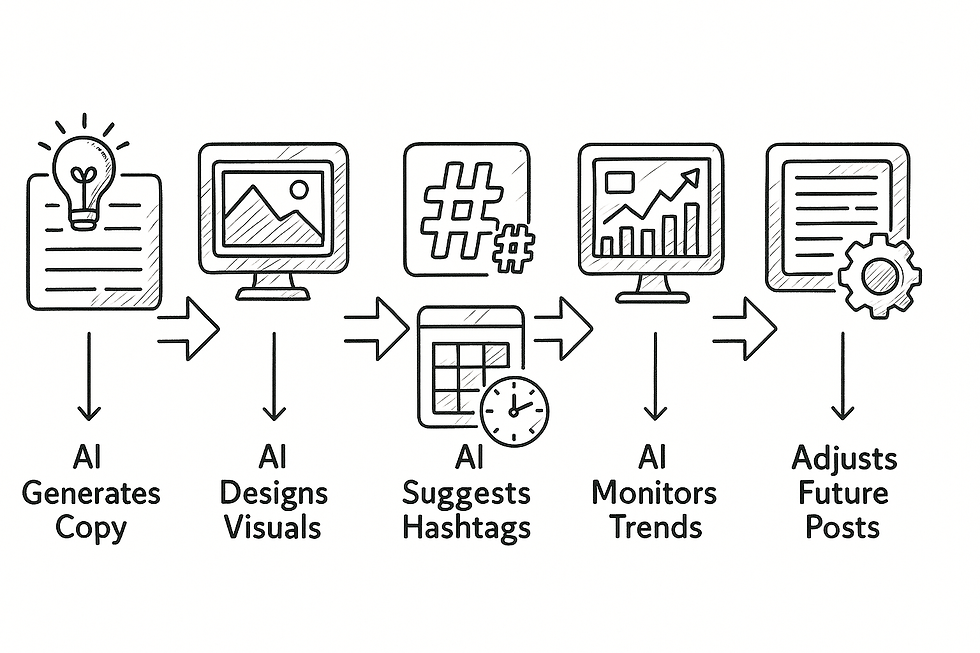
One of the most powerful features of these tools is the ability to create posts automatically from just a few lines of instruction. Predis.ai, for example, can take a short prompt such as “create a motivational Monday fitness post for young adults” and turn it into a complete social media design—graphics, captions, and suggested hashtags. Ocoya works in a similar way, offering ready-made content templates and AI-generated text that can match a brand’s tone or adapt to specific audiences. Canva Magic Write builds written content for visuals, turning rough ideas into polished captions, carousel slides, or short announcements ready for design.
Scheduling Made Effortless
Once the content is created, AI-driven scheduling removes the guesswork about when to post. Ocoya analyzes audience behavior and recommends ideal times based on engagement patterns. Predis.ai allows creators to map out an entire week or month of content in minutes, using automated recommendations to fill in gaps. With these tools, posting becomes a steady and predictable workflow rather than a scramble to keep up.
Hashtag Research and Optimization
Finding the right hashtags once meant scrolling through endless lists, copying what competitors used, and hoping for the best. AI handles this far more effectively. Predis.ai analyzes trending hashtags, compares their competitiveness, and matches them to your content category. Ocoya evaluates which tags historically attract the most engagement for similar posts. Canva Magic Write can also generate hashtag sets tailored to tone, niche, or call-to-action. These tools eliminate the trial-and-error approach and replace it with targeted, data-driven selection.
Reels and Short-Form Video Assistance
Short-form video has become the language of modern social media. AI tools now support creators by generating script ideas, caption overlays, and even editing suggestions for reels or TikTok-style videos. Predis.ai can generate a complete reel concept from a simple prompt like “30-second reel promoting a science learning kit for kids ages 8–12.” It provides transitions, suggested music, scene prompts, and on-screen text. Ocoya offers layout templates and automated resizing so videos fit each platform’s requirements without manual work.
Carousel and Multi-Image Post Generation
Carousels are ideal for storytelling, tutorials, or feature breakdowns. With AI, building them is far faster. Canva Magic Write can generate the text for each slide—step-by-step instructions, feature lists, or benefits summaries—while Canva’s design library handles the layout. Predis.ai converts a blog post, product description, or list of points into a multi-slide carousel that keeps a consistent visual style. This saves hours of formatting, copywriting, and design refinement.
Trend Analysis and Content Planning
One of the most valuable AI-driven abilities is trend monitoring. Social media shifts quickly, and AI can watch patterns across platforms in ways no human team can. Predis.ai identifies rising audio tracks, visual styles, and caption structures on Instagram and TikTok. Ocoya analyzes engagement spikes and suggests themes that are currently performing well in your niche. Canva provides idea prompts based on current seasonal or cultural trends. With these insights, brands can create timely content instead of constantly reacting after the moment has passed.
A Workflow Built for Creativity
The role of AI in social media creation and automation is not to replace the creator but to remove the obstacles that slow them down. These tools handle the repetitive tasks—scheduling, hashtag research, resizing, copywriting drafts—so creators can focus on their message, their story, and their connection to their audience. When used thoughtfully, AI transforms social media work from a frantic daily effort into a strategic, creative, and efficient process.
AI-Driven Visual Ad Design – Told by Claude Hopkins
In my time, visual advertising relied on artists, photographers, and layout specialists who worked with painstaking care to craft each poster or banner. Yet the essence remained the same: capture attention swiftly, hold it long enough to deliver meaning, and move the customer to action. Today, artificial intelligence has armed you with tools that can create these persuasive visuals at remarkable speed. Platforms like Canva Magic Write, generative image systems, and ad-template engines have transformed what once required days of labor into minutes of well-guided prompting.

The Role of Canva Magic Write in Modern Design
Canva Magic Write is not merely a text generator—it is a conceptual partner for your visual work. Provide a brief description of your idea, and it produces taglines, layout suggestions, or even slide-by-slide content for a multi-image ad. For example, if you ask it for “three headline options for a poster advertising a summer arts festival,” it will produce usable ideas instantly. It also suggests the structure of the design: where to place the title, how to balance imagery with text, or what emotional tone will best resonate. This combination of copy and concept provides a solid foundation before a single visual element is added.
Generative Image Tools and the Power of Rapid Creation
In my era, commissioning a new image for an advertisement was an undertaking that required careful planning and significant cost. Now, generative image tools can create a banner-ready visual from a sentence. A prompt such as “a bright, energetic digital painting of a runner at dawn for a sports shoe ad” can give you multiple variations within seconds. You can refine the prompt—changing color, mood, composition, or detail—until the image fits your exact intent. These tools allow you to test many concepts quickly, eliminating the guesswork that once defined much of advertising work.
Ad-Template Engines and Consistent Branding
Ad-template engines bring order and consistency to your creative process. They allow you to produce large batches of ads—thumbnails, posters, banners, and social graphics—that maintain a unified style. Instead of building each one from nothing, you select a template, feed the system your copy, and let AI adapt the layout automatically. This ensures that every ad in a campaign reflects the same visual identity, something I labored to achieve manually. It strengthens recognition and helps customers connect separate messages into a single, coherent brand narrative.
Creating Scroll-Stopping Visuals
The battle for attention has intensified in your age. Consumers scroll quickly, and an ad has only a moment to succeed or fail. AI helps meet this challenge by generating bold colors, dynamic movement, and composition that aligns with current visual trends. For instance, generative tools can analyze popular social media posts in your category and recommend styles—vibrant gradients, minimalist product displays, or high-contrast portraits. Canva Magic Write can pair these visuals with concise, compelling headlines that sharpen your message. The combination of tested style and thoughtful language results in ads that capture the eye and guide it toward the call to action.
Testing Visual Variations with Speed
One principle I held dear was testing. AI now allows you to test visual variations at a scale I could only dream of. You can produce five different thumbnails for the same video—each with alternate colors, facial expressions, or headline placements—then let your platform determine which performs best. You can adjust a poster’s layout based on click-through trends or refine a product banner by comparing heat-map data of where customers look first. Every part of the design becomes measurable, and every decision becomes more certain.
The Harmony of Art and Evidence
Though technology has changed, the purpose of advertising remains the same: present your product honestly and attractively to the right customer. AI tools do not replace the marketer’s judgment; they extend it. They remove the drudgery, accelerate exploration, and illuminate what works. When combined with careful oversight and a deep respect for the customer, AI-driven visual ad design becomes a powerful expression of the principles I championed. The craft is still yours. AI simply offers you better tools to practice it well.
AI Landing Pages, Funnels, and UX Personalization
Landing pages used to be static places—simple sales pitches in digital form. Funnels were linear paths that we hoped customers would follow, and personalization meant remembering a user’s name in an email. But with AI, every part of this experience has changed. Today, landing pages reshape themselves based on the person viewing them. Funnels shift, adapt, and re-route depending on behavior. UX becomes a living system that studies each visitor and responds in real time. This transformation turns your website into something closer to a conversation than a billboard.

Building Dynamic Landing Pages with AI
Modern AI-powered builders such as Unbounce Smart Traffic, HubSpot AI, and other optimization engines allow landing pages to adjust their content without manual edits. Imagine a page promoting an educational program. If a visitor is coming from a high-school parent group, the page may highlight college prep benefits. If the visitor arrives from a teacher’s forum, the same page might emphasize classroom integration and curriculum alignment. The AI identifies patterns—location, referral source, device type, browsing habits—and chooses which headline, hero image, or call-to-action to display. In just a few seconds, the landing page becomes a custom experience for that specific user.
Automated Funnel Optimization
Funnels today are no longer rigid. AI studies the behavior of a user at each stage—clicks, scroll depth, hover time, drop-off points—and automatically adjusts the funnel path to increase conversions. If a user consistently ignores long-form product descriptions, the AI may shorten those sections. If another user spends more time reading reviews, the funnel can shift to show more testimonials earlier. It works like a digital salesperson who notices your reactions and adapts its pitch in real time. This kind of automated funnel adjustment increases engagement and reduces friction because it removes guesswork from the design.
Personalizing User Experience with Dynamic Text and Imagery
AI-driven tools can change text, images, and offers depending on the visitor’s interests. For example, a visitor checking out an online gaming curriculum might see visuals featuring learners exploring virtual worlds, while a parent might see images of academic gains and structured learning paths. If a user has visited before and viewed math content, the landing page may highlight your math products first. Dynamic personalization ensures that the message matches the motivation. It reflects what users care about, not just what the business wants to say.
AI-Driven A/B Testing and Continuous Improvement
Instead of running one A/B test at a time, AI runs dozens of variations simultaneously. Headlines, buttons, colors, layouts, and product images can all be tested at once without overwhelming the designer. If Version B performs better for users coming from Instagram, the AI automatically serves that version to similar users in the future. This turns optimization into a continuous loop: observe, adjust, test, repeat. You don’t wait weeks for test results—you get improvements in real time.
Creating Meaningful User Journeys
The power of AI is not only in adapting to a user but also in anticipating what they might need next. If someone spends time reading about financial literacy, the funnel might present them with a free budgeting mini-course rather than a direct sales pitch. If a student is exploring educational games on STEM topics, the page might suggest relevant expansion packs or learning paths. What used to be generic funnels become journeys shaped around each individual’s progression, interests, and readiness.
The Future of Intent-Based Experiences
AI landing pages and funnels make the online experience feel personal, almost human. They understand behavior patterns, respond to preferences, and reduce friction. They do what a great salesperson does—listen first, then guide. This level of personalization creates trust and leads users to engage more deeply because the experience feels made for them. With the right prompts, strategy, and ethical oversight, AI helps you build not just better landing pages but meaningful digital interactions that support every learner, parent, and educator who arrives at your digital door.
AI for SEO, Keyword Research & Trend Forecasting
SEO used to be a slow craft built on patience, guesswork, and long spreadsheets of keywords. It required watching search trends manually, studying competitors, and testing phrases one at a time. But AI has changed everything. Now the process is faster, smarter, and more predictive. Instead of reacting to search behavior, we can anticipate it. Instead of guessing what people might look for, AI shows us patterns that would have stayed hidden. It has redefined how content creators, educators, and businesses rise above the digital noise.

AI-Powered Keyword Research
AI tools analyze millions of searches at once, breaking down how people phrase questions, what problems they’re trying to solve, and what language resonates with them. When I type a phrase like “Inca civilization learning tools,” AI doesn’t just give me related terms. It gives me intent-based clusters such as “Inca lessons for kids,” “hands-on Inca activities,” or “Inca empire homeschool curriculum.” These clusters reflect what users are actually trying to accomplish. Tools like Surfer SEO, Ahrefs’ AI assistants, and Semrush’s Keyword Magic Tool create lists that are dynamic—updated daily and influenced by real-time behavior. It’s no longer about finding the most popular keyword; it’s about understanding which phrases match your audience’s needs.
Trend Forecasting with AI
The most valuable advantage of AI is its ability to detect storms before they form. AI-driven forecasting tools look at rising patterns across Google, YouTube, TikTok, Amazon, and even social chatter. They highlight topics that are gaining momentum long before traditional tools detect them. For example, if a new educational trend emerges—like “AI in the classroom” or “gamified history lessons”—AI can identify it weeks early. Platforms such as Exploding Topics and Google Trends’ AI overlays scan thousands of micro-shifts in search behavior and predict which ones will become major waves. This helps creators and marketers produce content at the exact moment people begin searching for it.
Creating Optimized Blog Posts with AI
Once the keyword list is in place, AI helps craft the content itself. Give it a topic like “Benefits of project-based learning in homeschool environments,” and it can generate an outline informed by real search behavior. It suggests headings that match high-ranking results, structures the article so Google can parse it easily, and incorporates semantically related terms to improve relevance. With a refined prompt, it will also match brand tone, adapt sentence complexity for age groups, and embed calls to action naturally. Of course, human editing is essential—AI provides the backbone, but your unique voice gives it life.
Optimizing Product Pages and Descriptions
Product pages are the heart of online visibility, and AI has become a powerful assistant in shaping them. It analyzes competing listings, identifies what elements drive conversions, and recommends features to highlight. For example, if you’re listing a historical card game expansion, AI might reveal that users respond strongly to phrases like “hands-on history learning,” “family strategy game,” or “curriculum-aligned materials.” It can generate SEO-friendly product descriptions, create bullet points that emphasize benefits rather than features, and optimize meta tags so search engines can categorize the page correctly. This removes the guesswork from product positioning.
Writing Meta Descriptions That Get Clicks
Meta descriptions used to be an afterthought. Now they are crafted with precision. AI can generate dozens of variations, each designed to appeal to different motivations—urgency, curiosity, authority, or value. For a page about STEM learning games, AI might create options like “Discover STEM games that turn complex concepts into simple, hands-on adventures” or “Engage students with interactive STEM challenges that build real-world skills.” The key is testing. AI tools observe click-through rates, adjust language, and learn what tone resonates most with your audience. It becomes a cycle of improvement driven by data, not intuition.
Turning Data into Direction
The power of AI in SEO lies in its ability to combine observation with prediction. Instead of chasing trends after they peak, we can align our content with what’s rising now. Instead of manually checking each keyword or rewriting descriptions endlessly, we can focus our energy on big ideas while AI handles the groundwork. The goal is not to automate creativity but to amplify it. With AI analyzing search behavior and refining every step of the process, we can spend more time crafting stories, developing lessons, and creating products that genuinely help our audience. AI becomes the compass, and we remain the explorers.
AI for Analytics, A/B Testing & Data Interpretation
There was a time when analytics were nothing more than guesswork wrapped in spreadsheets. Marketers stared at charts, hoping to discover why one campaign succeeded while another fell flat. Today, AI has turned that uncertainty into clarity. With tools like HubSpot AI and modern analytics platforms, we finally have systems that can translate user behavior into understandable stories. Instead of digging for insights, the insights come to us—quickly, accurately, and with context we never had before.

Understanding Audience Behavior Through AI
When a visitor interacts with your website, every movement becomes a data point—scrolling, clicking, hesitating, returning, or bouncing away. HubSpot AI examines these patterns and identifies what the human eye easily misses. It can tell you where customers lose interest, which pages hold their attention, and which emails influence their next steps. For example, if a parent visits a curriculum page twice but never completes the purchase, AI may reveal that they need more trust-building content, such as testimonials or sample lessons. If a student interacts heavily with interactive game previews, AI can detect that interest and guide them toward similar learning tools. All of these observations happen automatically, without the marketer needing to sift through endless reports.
A/B Testing at a New Level of Precision
A/B testing used to require patience. You created two versions of a headline, waited weeks for enough traffic, and hoped the difference was meaningful. Now AI tests dozens of variations simultaneously. It evaluates the performance of each variation by audience segment, time of day, device type, and even emotional tone. For instance, HubSpot AI might discover that a friendly, conversational headline works best for mobile users, while a more direct version performs better for desktop users who are browsing with purpose. Instead of running independent tests, AI runs continuous cycles—learning, adapting, and deploying the winning elements to the right audience automatically.
Attribution Pathways and Customer Journeys
One of the most difficult problems in marketing has always been attribution: how do you know which action or message convinced a person to buy, subscribe, or return? AI has changed this process entirely. It maps the customer journey like a branching tree, showing the pathways that lead to conversion. A visitor might first see a social media ad, then read a blog post, then watch a video, then finally click an email. AI tracks every step and determines which touchpoints created the most meaningful influence. With that knowledge, you can invest in the right content and scale what works. In one case, AI may reveal that parents respond most strongly to video walkthroughs of your curriculum. In another, it may show that students convert higher when they encounter interactive content before reading long descriptions. These insights are nearly impossible to discover manually.
Predictive Analytics and Anticipated Outcomes
AI does more than track what already happened—it predicts what will happen next. Predictive analytics identifies which leads are most likely to convert, which customers are drifting away, and which type of content will drive engagement tomorrow. HubSpot AI gives each lead a score driven by behavior patterns, telling you who needs more nurturing and who is ready for a direct offer. Predictive models can even warn you when certain pages or posts are losing relevance, giving you time to refresh content before it slides down search rankings. This forward-looking approach allows campaigns to remain relevant and effective.
Turning Data Into Actionable Strategy
The true strength of AI analytics is not the data itself but what it helps you do with that data. AI highlights which messages resonate, which visuals capture interest, which email subject lines perform, and which user pathways are the most efficient. With that information, you can refine your campaigns with confidence. You can eliminate what doesn’t work, double down on what does, and build user experiences that feel intentional. Instead of guessing how people behave, you build based on measurable truth. In the end, AI analytics give you something that every creator and marketer strives for: the ability to make decisions grounded in understanding rather than speculation.
AI for Video Ads & Short-Form Content
Short-form video has become the heartbeat of modern marketing. Platforms like TikTok, YouTube Shorts, and Instagram Reels thrive on quick storytelling—moments that catch the eye, deliver a message, and leave the viewer wanting more. What used to require cameras, scripts, editors, and days of production now happens in minutes with AI. Marketers can generate scripts, voiceovers, B-roll, captions, and edits simply by describing what they want. This shift has made video creation accessible, fast, and adaptable in ways we’ve never seen before.

Generating Scripts with AI
The foundation of any compelling video is a strong script. AI tools can produce them instantly from simple prompts. For example, if I type, “Create a 20-second TikTok script that introduces a history-themed game for middle school students,” the AI will outline scenes, write dialogue, and even suggest pacing. These scripts often begin with a hook designed to grab attention within the first two seconds—a critical requirement for social platforms. You can adjust tone, speed, humor, or emotion with a single follow-up prompt, allowing rapid iteration without lengthy rewrites.
AI Voiceovers and Audio Production
Once the script is ready, AI voiceover tools step in. Instead of hiring voice actors or recording your own audio, you can choose from dozens of realistic voices—youthful, professional, warm, authoritative, or energetic. These voiceovers can match the timing of your script automatically. AI can even generate alternate versions: one for parents, one for teachers, one for students. This flexibility gives marketers the ability to test different voices and see which drives the highest engagement. The days of waiting on studio sessions or microphone setups are gone; AI makes narration nearly instantaneous.
B-Roll and Visual Fillers on Demand
Video editors know how much time goes into gathering the right B-roll footage. AI changes that entirely. Modern tools can generate B-roll scenes from text. Ask for “a shot of a student opening a learning kit” or “a sweeping view of an ancient civilization recreated in a virtual world,” and AI produces usable footage or recommended stock clips. It can also assemble B-roll automatically based on script context, identifying phrases like “hands-on learning” or “adventure” and selecting visuals that match. This means marketers can create fuller, more dynamic videos without extensive footage libraries.
Automated Vertical Video Editing
Short-form content requires vertical formatting, fast cuts, zooms, captions, and transitions that fit the rhythm of each platform. AI video editors take long videos and create multiple short-form versions automatically. They find the most exciting moments, punch in on faces, adjust pacing, and add visual emphasis. For product demonstrations or educational content, AI can highlight key actions, track items on screen, and adjust framing to keep the viewer locked in. These automatic edits save hours of manual work and allow creators to publish multiple variants for testing.
AI Hooks, Captions, and Subtitles
Hooks determine whether a viewer stops scrolling. AI generates dozens of hook options—from bold statements to intriguing questions to emotional appeals. For a STEM learning kit, hooks might include “Stop teaching STEM the old way” or “This learning game changed my homeschool routine.” AI not only writes these hooks but places them visually on the screen with animated captions. Subtitles are generated automatically, synced perfectly to the voiceover, and styled to match platform trends. This is essential for accessibility and for users who watch with sound off.
Smart Adaptation Across Platforms
Each platform has its own culture, pacing, and audience expectations. A TikTok video might rely on humor and quick cuts, while YouTube Shorts might favor clarity and mini-tutorials. AI helps repurpose a single script into platform-specific formats. The same idea can become three different versions, each tailored to maximize engagement where it’s posted. This multiplies reach without multiplying effort.
Storytelling at the Speed of Ideas
AI for video ads and short-form content amplifies creativity rather than replacing it. You still decide the story, the emotion, the message, and the purpose. AI simply removes the technical barriers and time constraints that once slowed video production. With these tools, your ideas move from imagination to screen in minutes. It empowers marketers, educators, and storytellers to meet audiences where they are—scrolling fast, consuming quickly, and craving content that speaks directly to them.
Ethical AI Advertising & Responsible Data Use
AI has given us extraordinary tools—ones that can write ads, analyze behavior, and personalize content faster than any human team. But great power, as the old saying goes, demands great responsibility. When machines can influence decisions, track behavior, and create persuasive messages in seconds, we must be even more careful about how we use them. Ethical AI advertising is not just a professional standard; it is a moral obligation to ensure trust, fairness, and transparency in every message we send.

Transparency in AI-Generated Content
One of the foundations of ethical advertising is honesty about how content is created. When AI writes a headline or designs a visual, it’s important that educators, students, and marketers understand where that content comes from and how it was produced. This doesn’t mean labeling every ad “created by AI,” but it does mean understanding that machine-generated content is fallible. It may misinterpret context or create copy that sounds authoritative but lacks factual grounding. Transparency—especially in educational or youth-oriented advertising—helps maintain trust. When testing AI tools in class, I tell students: “Always ask where the information came from, and double-check it before using it.”
Respecting Privacy in a Data-Driven World
AI thrives on data, but data comes from real people with real lives. When we collect browsing behavior, location patterns, or interests, we must handle this information responsibly. Tools that track user interactions on websites or analyze customer preferences should be configured with privacy in mind. That means following laws like COPPA for children, FERPA for educational content, and state privacy acts such as California’s CCPA. It also means obtaining consent, storing data securely, and avoiding collection of unnecessary details. Students learning marketing must know this: data is not a shortcut to manipulation; it is a privilege granted by the user, one that must be guarded with care.
Avoiding Manipulative or Misleading Ads
AI systems can generate messaging that is persuasive, emotional, and even urgent—sometimes too urgent. Marketers can accidentally cross ethical lines by exaggerating benefits, fabricating scarcity, or creating fear-based messaging. When AI is involved, the risk increases because the machine optimizes for engagement, not integrity. That is where human oversight becomes essential. Educators must teach students to evaluate AI-generated copy for accuracy, fairness, and truthfulness. The question is not “Will this sell?” but “Is this honest, respectful, and aligned with our values?” Advertising should empower people, not exploit their vulnerabilities.
Copyright and the Use of AI-Generated Material
One of the growing debates in today’s courts revolves around whether AI-generated content infringes on copyrighted works. Some lawsuits claim that AI models were trained on copyrighted texts or images without permission. Others argue that AI-generated output is too close to existing material. For students and educators, the lesson is simple: always treat AI output as a draft, not a final product. Check for similarity to known sources. Ensure images or text don’t mimic specific artists or authors. And when publishing anything publicly, use platforms that provide commercially safe generation modes. Copyright is not just a legal hurdle—it’s a way of respecting creators whose work built the world of ideas we rely on.
Best Practices for Educators
When teaching ethical AI advertising, educators should frame the conversation around responsibility. Encourage students to:• Review AI-generated content for accuracy and fairness.• Analyze whether messaging exploits emotions or vulnerabilities.• Understand privacy laws and data consent requirements.• Use citation and documentation practices for any research-backed claims.• Discuss real examples of ethical dilemmas in advertising.• Test AI tools in low-risk environments where mistakes become lessons, not liabilities.These practices build habits that protect both creators and consumers.
Best Practices for Students and Young Marketers
Students entering the world of AI marketing should follow a few core principles. First, always question AI output—don’t assume it’s correct. Second, choose transparency over shortcuts; if you don’t know whether something is ethical, stop and find out. Third, understand that personalization should feel helpful, not invasive. Fourth, avoid copying styles or voices too closely from specific creators. Finally, remember that your reputation as a marketer depends not just on creativity or results, but on integrity. Ethical habits built early shape careers that uplift, not manipulate.
A Future Built on Trust and Responsibility
The purpose of advertising has always been to communicate—clearly, honestly, and effectively. AI gives us more tools, more speed, and more reach, but none of that replaces the human responsibility at the core of communication. Ethical AI advertising ensures that the technology serves people, not the other way around. When we protect privacy, avoid manipulation, follow copyright law, and remain transparent, we create a digital world where innovation and integrity walk side by side. This is the kind of marketing future worth building—one grounded in trust, clarity, and respect.
Vocabular to Learn While Learning About AI Animation Virtual Worlds
1. Personalization
Definition: Changing content or messages to fit the interests or behavior of a specific person.Sentence: The website used personalization to show different product suggestions to each visitor.
2. A/B Testing
Definition: A method that compares two versions of an ad or webpage to see which performs better.Sentence: We ran A/B testing on two headlines to find out which one encouraged more people to sign up.
3. Conversion Rate
Definition: The percentage of people who take a desired action, such as making a purchase or subscribing.Sentence: After improving the landing page, the conversion rate increased by ten percent.
4. Target Audience
Definition: The specific group of people a marketing message is meant to reach.Sentence: Our target audience for the video ad was high-school students interested in learning games.
5. Analytics
Definition: The process of gathering and studying data to understand behavior and improve decisions.Sentence: The analytics dashboard showed which ads were working and which ones needed changes.
6. Funnel
Definition: A step-by-step path that guides a customer from discovering a product to buying it.Sentence: The AI redesigned our funnel so that parents saw testimonials before reaching the purchase page.
7. Segmentation
Definition: Dividing customers into smaller groups based on shared traits or behaviors.Sentence: Through segmentation, the AI learned that adults preferred informational posts while teens liked humor.
8. Metadata
Definition: Information that describes other data, such as a webpage’s title or description.Sentence: We updated the metadata on our product page to help search engines understand what it was about.
9. Retargeting
Definition: Showing ads to people who have visited a website but did not complete an action.Sentence: Retargeting allowed us to remind parents about the educational kit they viewed earlier.
10. Trend Forecasting
Definition: Predicting future styles, topics, or behaviors using data and patterns.Sentence: Using AI trend forecasting, we created videos that matched what students were already watching online.
Activities to Demonstrate While Learning About AI Animation Virtual Worlds
Create an AI-Generated Ad Campaign – Recommended: Intermediate to Advanced Students
Activity Description: Students use AI tools (ChatGPT, Canva Magic Write, and Predis.ai/Ocoya) to create a mini advertising campaign for a fictional or real product—such as a game, snack, school event, or club.
Objective: To help students understand how AI assists in ad copywriting, design, and social media messaging.
Materials:• Internet-connected device• ChatGPT or Jasper.ai• Canva (free version)• Predis.ai or Ocoya (free trial works)• Optional: printed rubric
Instructions:
Ask students to choose a product they want to promote.
Have them use ChatGPT to generate headlines, taglines, and a short ad script (10–20 seconds).
Using Canva Magic Write, students create one poster or digital banner with AI-assisted copy.
Using Predis.ai or Ocoya, they generate a social media post with hashtags.
Students present their ad campaign to the class or parents.
Learning Outcome: Students gain hands-on experience using AI copywriting and design tools, learn how messaging influences buyers, and understand how ads are made across multiple platforms.
A/B Test Your Own Headlines – Recommended: Intermediate to Advanced Students
Activity Description: Students write two versions of an advertisement headline and test them using a simulated audience (class votes) or an AI tool that predicts engagement.
Objective: To teach the concept of A/B testing and why marketers test multiple versions of content.
Materials:• ChatGPT or Copy.ai• Whiteboard or Google Slides• Simple poll tool (Google Forms, Mentimeter, or classroom voting)
Instructions:
Students choose a simple product (school event, snack, game).
Use AI to generate two or three possible headlines.
Display each headline to the class.
Students vote which one they find more persuasive.
Discuss why certain words or phrasing had more impact.
Optional: Run the headlines through an AI “predictive score” tool such as Headline Analyzer.
Learning Outcome: Students understand why marketers test variations, how small wording changes affect engagement, and how AI assists with optimizing communication.
Build a Personalized Landing Page With AI – Recommended: Intermediate to Advanced Students
Activity Description: Students use AI tools to create two versions of a landing page—one for teens and one for parents—and compare how personalization works in marketing.
Objective: To demonstrate how AI-driven landing pages adjust language, visuals, and layout depending on the target audience.
Materials:• ChatGPT or HubSpot AI (free account options)• Canva for simple mockups• Notetaking sheet
Instructions:
Assign students a product such as a summer camp, school fundraiser, or educational kit.
Ask them to create two audience profiles: a teen visitor and a parent visitor.
Using AI, generate two sets of headlines, benefits, and calls to action.
Students design simple mock landing pages in Canva or draw them on paper.
As a class, compare how the messaging changes between audiences.
Learning Outcome: Students learn the basics of segmentation, personalization, and UX, understanding how marketers communicate differently with specific groups.
AI Trend-Spotting Challenge – Recommended: Intermediate to Advanced Students
Activity Description: Students use AI tools to identify current digital media trends—popular phrases, viral styles, popular hashtags—and predict what might trend next.
Objective: To help students understand trend forecasting and how AI identifies rising interests in marketing.
Materials:• ChatGPT or Perplexity.ai• Google Trends (free)• Social platform (TikTok, YouTube Shorts, or Instagram—teacher-monitored)• Worksheet for predictions
Instructions:
Have students ask AI to list trending topics for teens, gaming, education, or another category.
Students compare AI’s list with Google Trends.
They choose one trend and predict how it might evolve.
Each student designs a simple “trend-based” ad post using Canva.
Present predictions to the class.
Learning Outcome: Students understand how trends influence marketing and how AI tools help brands stay current and relevant.
Creating a Full AI-Powered Marketing Plan
When I teach students or new entrepreneurs how to build a marketing plan, I never start with spreadsheets or calendars. I start with momentum. Marketing is storytelling fueled by structure. And with AI tools, you can build that structure faster than ever before. Today, I’ll walk you step-by-step through a full activity that shows how to create an entire marketing plan—strategy, schedule, content, and materials—using real AI tools, real prompts, and real workflows you can try immediately.
Step 1: Defining the Mission With AI Strategy Tools
Before we create anything, we ask AI to help us shape the direction. Open ChatGPT (https://chat.openai.com) or Claude (https://claude.ai) and paste this prompt:“Act as a senior marketing strategist. Create a complete marketing plan for my product: [describe product], including mission statement, audience segments, marketing goals, KPIs, and a 30-day content strategy. Write it in simple language for students.”AI will give you the core blueprint. This becomes your master document—your map before the journey begins.
Step 2: Building Audience Segments With AI
Next, we use AI to shape our ideal customers. Go into HubSpot’s free persona builder (https://www.hubspot.com/make-my-persona). Continue refining in ChatGPT with this prompt:“Create three customer personas for my product. Include their goals, fears, buying behavior, online habits, and what type of messaging they respond to.”Now the campaign has faces, names, and motivations—essential for authentic marketing.
Step 3: Generating the Content Calendar
Now we create a 30-day calendar. Use Notion AI (https://www.notion.so) or Google Sheets with ChatGPT. Prompt:“Create a detailed 30-day marketing schedule for my product including daily social posts, weekly email topics, TikTok/Reels ideas, blog post titles, and promotional peaks. Include ideal posting times based on engagement research.”In seconds, you have a marketing month mapped out like a professional agency’s plan.
Step 4: Writing the Copy—Ads, Emails, and Messages
Now we generate the words. Open Jasper.ai (https://www.jasper.ai) or Copy.ai (https://www.copy.ai). For social posts, use this:“Write 10 social media captions promoting [product], each with a unique tone: inspirational, humorous, educational, urgent, storytelling. Include 10 matching hashtag groups.”For emails, prompt:“Write a 5-email marketing campaign introducing [product], including a welcome email, a benefits breakdown, a testimonial email, a myth-busting email, and a final call to action.”For ads, prompt:“Write 10 headline variations and 10 primary text variations for Facebook and Instagram ads promoting [product].”You now have enough messaging for nearly every platform.
Step 5: Creating the Visuals With AI Design Tools
We bring the copy to life with visuals. Open Canva Magic Write (https://www.canva.com/magic-write/) or Adobe Express (https://www.adobe.com/express). Use this prompt inside Canva:“Create a set of marketing graphics for [product]: 3 Instagram posts, 2 Reels covers, 2 posters, 2 email banners, and 1 website hero image. Use a friendly, bold style with high contrast and simple icons.”For social videos, use Predis.ai (https://predis.ai) with this prompt:“Generate a 15-second product promo video for [product] with text overlays, upbeat music, and a call to action.”Your entire visual suite appears in minutes.
Step 6: Building AI-Optimized Landing Pages
Now we need a place to send people. Open Systeme.io (https://systeme.io), HubSpot (https://hubspot.com), or Unbounce Smart Builder (https://unbounce.com). Use this prompt with ChatGPT:“Write copy for a high-converting landing page promoting [product], including headline options, subhead, bullet benefits, testimonial placeholders, pricing explanation, FAQ, and final CTA.”Paste the content into your page builder, add your AI images, and your funnel is ready.
Step 7: Scheduling Everything Automatically
Time to put the campaign on autopilot. Go to Ocoya (https://www.ocoya.com) or Later.com (https://later.com). Use AI scheduling features to:• Upload your graphic posts• Connect Instagram, Facebook, TikTok, and YouTube• Auto-schedule posting times based on best engagementAsk ChatGPT:“Give me the optimal posting schedule for my 30-day content calendar, based on current platform engagement research.”You now have a full automated campaign.
Step 8: Creating Ads and Tracking Success
Open Meta Ads Manager or Google Ads. For ad copy, use AI to create variations:“Generate 12 variations of this ad text focusing on different emotional angles: trust, excitement, savings, fear of missing out, simplicity, and transformation.”Then use your analytics tools (HubSpot AI or Google Analytics) to track:• Best-performing posts• Highest-converting videos• Strongest headlines• Weakest links to improveAI gives weekly summaries using this prompt:“Explain my campaign’s performance this week in simple language and identify exactly what I should improve next.”
Step 9: Creating the Feedback Loop
Marketing without feedback is noise. AI makes the loop simple. Every week, run this prompt:“Analyze my content performance from this data: [paste in analytics]. Tell me what types of content I should increase, decrease, or redesign. Propose a new 7-day plan based on the results.”Your plan now evolves—alive, adjusting itself week after week.
Step 10: Bringing It All Together
By the time you finish this activity, you have:• A complete AI marketing strategy• A 30-day content plan• Ads, scripts, visuals, and emails• A landing page• A social media schedule• A repeating analytics routineThis is how professionals build campaigns—only now, with AI, students and parents can do it right from home, guided step-by-step.


Comments